
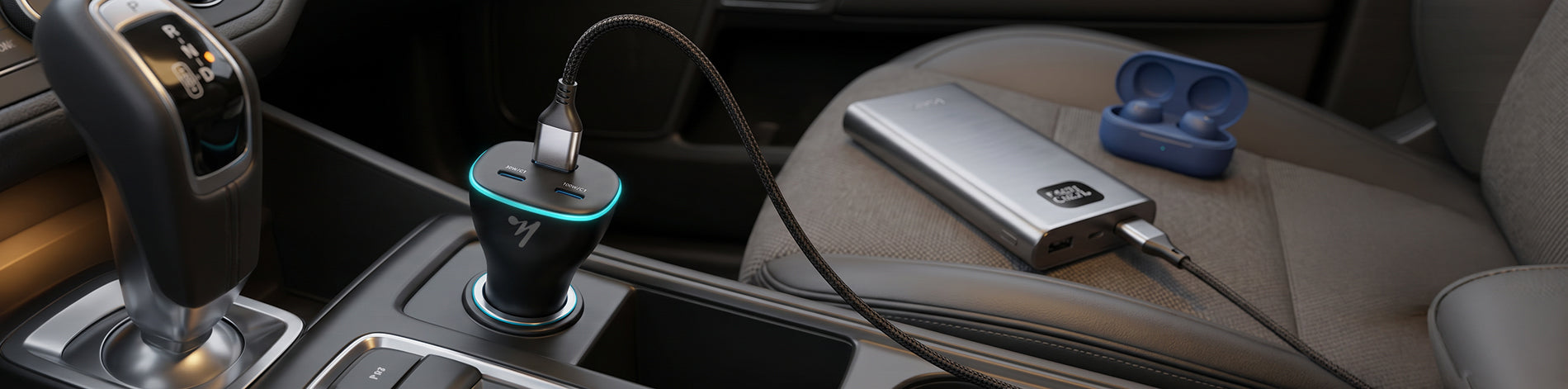
Best Budget Car Chargers in India: Fast, Safe Charging Without the Big Spend
You plan the road trip, queue up the playlist, hit the highway — and twenty minutes in, your phone's already begging for a charger. Here's how to fix that for good, without overspending.
Most of us have lived this one. You map out a long drive, line up your favourite playlist, get on the highway — and fifteen minutes later your phone is down to single digits. These days none of us can really function without our phones on the road (maps, music, calls, UPI at the toll), so leaving home on a half-empty battery is asking for trouble.
The good news: keeping your devices charged on the move doesn't need a big spend anymore. Premium-level charging speeds in your car used to cost a premium. Not now. As India's accessory market has matured, the price of genuinely good tech has dropped hard, and finding a safe, fast, reliable car charger is easier than it's ever been. Below, I'll walk through what actually makes a good budget charger, and which styles Indian drivers are buying most.
Why a Cheap, Random Car Charger Doesn't Work Anymore
Before we get to the good options, let's name the trap most people fall into: grabbing a random unbranded plastic adapter from a corner shop or a traffic-signal vendor. It feels like a bargain. It usually isn't. Those cheap chargers tend to fail in three ways.
1. They overheat
Poor voltage control means the adapter runs hot, and that heat slowly chips away at your phone's long-term battery health.
2. They're painfully slow
Most only push out a weak 5W or 10W. Run Google Maps and stream music at the same time and a charger like that barely keeps up — sometimes it just slows how fast your battery drains rather than actually charging it.
3. There's no real safety protection
Your car's alternator can send sudden electrical surges down the line. A cheap accessory passes that straight through — and it can permanently damage your phone's motherboard.
Spend a little more on a certified budget charger and the whole experience changes: faster speeds, plus safety chips that protect the expensive device you're plugging in.
What to Look for When Buying a Budget Car Charger
Keep these three things in mind as you browse the car charger options at Wozoyo (or anywhere else):
1. Fast-charging protocols — PD vs QC
Phones "speak" different charging languages, and you want a charger that speaks yours.
- Power Delivery (PD) — the universal standard, over USB-C to USB-C or USB-C to Lightning. It's what iPhones, Google Pixels and most Samsung phones use (PD = the fast-charging protocol most modern phones default to).
- Quick Charge (QC) — Qualcomm's standard, common on older OnePlus phones and mid-range Androids like Realme and Xiaomi that still use USB-A ports.
The safest future-proof pick is a dual charger with one USB-C (PD) port and one USB-A (QC) port — it covers old and new phones in the same car.
2. Wattage — this is basically your speed
Wattage is the number that decides how fast you charge. A basic port gives you 10W–12W. Genuine fast charging starts around 18W–20W. If you want to top up newer phones quickly — and charge the driver's and passenger's phones at once — look for a total output of 30W to 45W shared across the ports.
3. Build and form factor
Decide what suits your car. Some people want a chunky unit with an LED display showing live battery voltage; others prefer a slim charger that sits flush in the socket and disappears. Either way, favour fire-resistant polycarbonate or aluminium-alloy builds over flimsy plastic.
The 3 Best-Selling Budget Car Charger Styles in India
Indian buyers care about value, so manufacturers have built distinct budget adapters for different driving habits. These are the three that keep selling.
1. Ultra-Compact Flush-Fit Chargers
These little engineering marvels are usually made of sleek metal alloy and slide almost entirely into your DC socket — barely anything sticks out. Most include a small pull-ring so you can remove them when you need to. They're typically dual-port (USB-A + USB-C) with a combined 30W.
Who it's for: drivers who want a tidy console with no bulky accessory hanging out.
2. Heavy-Duty Multi-Port Hubs
If you drive with family every day, carpool with colleagues, or juggle several devices (personal phone, work phone, an iPad), two ports won't cut it. Multi-port budget chargers offer three to four ports — some even extend a braided cable to a clip-in hub for back-seat passengers. Combined output usually runs 45W to 65W, so several phones charge steadily without cooking the main plug.
Who it's for: families, road-trippers, taxi drivers, and anyone charging multiple devices at once.
3. Digital Display (Smart Voltmeter) Adapters
Several popular budget models in India carry a small, bright LED screen on the plug face. Start the ignition and it shows your car battery's voltage; plug in your phone and it switches to the live charging current.
Who it's for: car enthusiasts and owners of older vehicles who like to keep an eye on battery health while they charge.
How to Get the Most Out of Your Car Charger
How you use the adapter decides how long it lasts and how fast your phone fills up. Three habits worth building:
Pair it with a good cable
A 45W charger means nothing if you connect it with a frayed, no-name cable — your speed drops instantly. Match a fast adapter with a cable rated for both data and high wattage.
Plug in after a cold start
Modern chargers are well protected, but the surge a car draws to crank the engine can cause slight fluctuations. Start the car first, then plug your phone in.
Keep the socket clean
Cigarette-lighter sockets collect dust, debris and ash. If your charger keeps connecting and disconnecting, switch the car off and give the socket a quick wipe with a dry microfibre cloth.
Where to Find a Budget Car Charger You Can Trust
With budget chargers, you're really looking for verified quality without a silly markup. Big marketplaces are full of clones, so a dedicated tech-accessory platform is usually the safer bet. When you browse a curated range like the Wozoyo Car Chargers catalog, you're looking at products picked for reliability, design and safety testing — with genuine customer support and warranties behind them, which third-party sellers rarely offer.
Budget Car Chargers: Quick FAQ
What wattage car charger do I need in India?
For real fast charging, aim for at least 18W–20W per port. A total output of 30W–45W across two ports lets a driver and passenger charge newer phones at full speed at the same time.
What's the difference between PD and QC?
Power Delivery (PD) uses USB-C and is the standard for iPhones, Pixels and most Samsung phones. Quick Charge (QC) is Qualcomm's standard, common on older USB-A devices from OnePlus, Realme and Xiaomi. A dual-port charger with one USB-C (PD) and one USB-A (QC) covers both.
Are cheap unbranded car chargers safe?
Often not. Cheap adapters can overheat, charge slowly and lack surge protection — which can harm your phone's battery or motherboard. A certified budget charger with proper safety chips is a safer bet.
The Bottom Line
A good budget car charger is one of the smartest small buys you can make as a car owner. No more dimming your screen to save power, killing Bluetooth to squeeze out battery, or sweating a dead phone in an unfamiliar part of town. Grab a fast, dual-port metal adapter and you get the quiet confidence of knowing a full battery is only a short drive away.
Ready to stop running on empty?
Browse fast, safety-tested car chargers built for Indian drivers.
Shop Wozoyo Car Chargers →Prices and specs vary by model. Always match your charger's wattage and port type (PD/QC) to your specific phone for the fastest safe charging.