
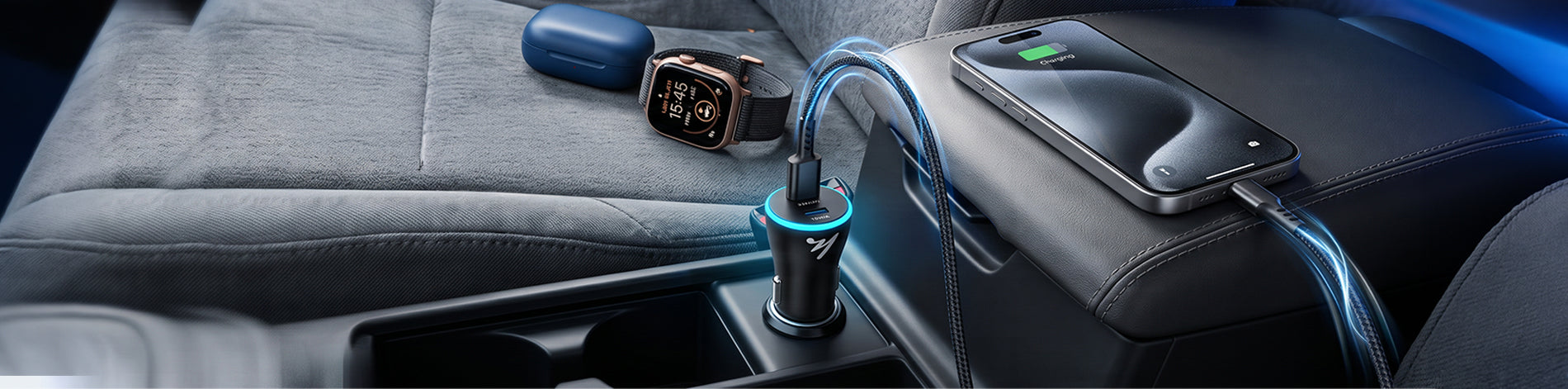
How to pick the right car charger for your ride in 2026
I think pretty much all of us have been in that spot where you’re driving through streets you don’t know, leaning hard on your phone’s GPS to get you home. You’ve got your favorite music streaming, everything is fine, and then—bam—you see that little battery icon flashing red at you. It’s the worst feeling, honestly. You’d think plugging it into that little USB port that came built into your car would fix it, but nope. Sometimes, after driving for like 30 minutes, you look down and the battery is actually lower than when you started. It’s just… really frustrating.
The thing is, phones today are basically supercomputers in our pockets. They’re way more powerful than they used to be. Most of those standard 5W USB ports that come in car dashboards just can’t keep up anymore. They might have worked fine ten years ago, but for modern phones, dashcams, or even tablets and laptops, they’re kinda useless. You really need a dedicated car charger if you want to keep your stuff from dying on a long trip. But if you go online to buy one, it’s honestly a total mess. There are so many options and weird technical terms that it’s hard to know what you’re even looking at.
You start seeing stuff like GaN tech, Quick Charge, Power Delivery, and wattage numbers ranging from 15W to over 100W, and it’s just… a lot. Picking one that won't fry your phone but still charges it fast isn’t as easy as it sounds. So, I wanted to put together some simple tips to help you figure out which car charger is actually worth your money in 2026.
1. Figure out how much power your stuff actually needs
The very first thing you gotta do is make sure the charger actually puts out enough "juice" for your devices. We usually measure this in watts (W). If you’re curious about the math, it’s basically just multiplying voltage by current, but you don't really need to worry about that too much. Just look at the W number.
If you get a charger that doesn't have enough watts, your phone is going to charge so slowly it’ll drive you crazy. Or, even worse, it might not charge at all. Honestly, it’s usually better to just get one with a higher wattage than you think you need. Your phone is smart enough to only take what it can handle, so you won’t break anything. Plus, it kind of "future-proofs" your car for whatever new gadget you buy next year. It’s just safer that way.
What most gadgets need for power in 2026
| The Device | How much power it wants |
|---|---|
| Fancy new phones (iPhone 16 or 17, Samsung Galaxy S25/S26 Ultra) | Somewhere between 30W and 45W |
| Regular smartphones (like older iPhones or Samsungs) | About 18W to 27W |
| Tablets and iPads | Usually 30W or 35W |
| Light laptops like the MacBook Air | 45W to 65W |
| Big laptops or gaming ones | You’re looking at 65W all the way up to 100W |
So, if you’re trying to charge a laptop while you’re commuting to work, a basic 15W charger is just not going to cut it. You’ll be sitting there forever. You really want to look for something that can push out at least 45W or 65W from a single port if you want it to actually work well.
2. Pay attention to the "charging language": USB-PD vs. Quick Charge
Having a lot of power is great, but it doesn't mean much if the charger and your phone can't talk to each other. These "protocols" are basically like a secret handshake between the charger and your device to make sure everything is charging as fast and as safely as possible.
USB Power Delivery (USB-PD)
This one is pretty much the gold standard now. It’s what Apple uses for iPhones, and it’s also used by Google Pixels, tablets, and almost all laptops. If you want to use this, you’re going to need a USB-C to USB-C cable (or a USB-C to Lightning one if you’ve got an older iPhone).
In 2026, you should really try to find a charger that supports something called USB-PD 3.1 with PPS. PPS stands for "Programmable Power Supply," which sounds fancy, but it just means the charger is smart enough to change the power on the fly. This keeps your phone from getting too hot and helps your battery last longer over the years. It’s just better for your tech.
Qualcomm Quick Charge (QC)
Then there’s Quick Charge. This is mostly an Android thing, specifically for phones that use Snapdragon processors. A lot of older accessories still use Quick Charge 3.0 with the old-school USB-A ports. Most new stuff is moving toward USB-C, but if you can find a charger that does both PD and QC, you’re pretty much set for whatever device anyone brings into your car.
3. Think about how many ports you actually need
You don’t want to be fighting with your passengers over who gets to charge their phone, right? It’s always a good idea to have a few extra spots to plug things in.
USB-C should be your main focus
Seriously, USB-C is the king now. It’s faster, it handles more power, and it’s what everything uses. When you’re looking at chargers, make sure it has at least one or two USB-C ports. That’s where the real speed is.
Maybe keep one old USB-A port around
Even though everything is moving to USB-C, it’s still kinda handy to have one of those old-style USB-A ports. Maybe you have an old dashcam that still uses it, or a Kindle, or some random wireless mount. Having both types of ports just makes life a little easier, you know?
Don't let "total wattage" trick you
This is a big one. Companies love to put "50W" in big letters on the box, but sometimes that’s just the total of all the ports added together. Like, it might be 25W for one port and 25W for the other. If you plug two things in at once, the speed might drop way down. Always double-check how much power each individual port can actually give you.
4. Check what it's made of and how it’s built
How the charger is built on the inside actually matters a lot. Older chargers used to use silicon parts that would get super hot if you used them for too long. Nobody likes a charger that feels like it’s going to melt.
Nowadays, the good chargers use something called Gallium Nitride, or GaN for short. It’s way more efficient than the old stuff. It stays cooler, and it lets companies make these tiny little chargers that can still put out like 100W of power. It’s kind of crazy how small they can be now.
Aluminum or Zinc Alloy
If you can get a charger made of metal, like aluminum, go for it. It helps the heat escape better, and honestly, it just looks and feels a lot nicer in your car. It feels more "premium" and less like a cheap piece of plastic.
Fire-resistant plastic
Plastic is fine too, as long as it’s high-quality polycarbonate. Just make sure it has safety labels like UL or CE on it. You don’t want to risk a fire just to save a few bucks on a charger.
5. Whatever you do, don't skip the safety stuff
Cars are kind of weird with electricity. The power coming out of that 12V socket isn’t always steady. You can get these random spikes in voltage, and if you have a cheap, crappy charger, that spike could go straight into your phone and fry it. That’s a really expensive mistake.
You definitely want to make sure your charger has these safety features built-in:
- Short-Circuit Protection: This basically kills the power instantly if something goes wrong so nothing catches fire.
- Over-Voltage Protection: This acts like a shield against those random power spikes from your car.
- Over-Current Protection: This keeps too much electricity from flowing at once, which is a big fire hazard.
- Over-Temperature Protection: If the charger starts getting way too hot, it’ll either slow down or shut off so it can cool down.
A quick checklist to find the right one
| What to look for | What I’d recommend |
|---|---|
| Total Power | Go for 30–45W for phones, or 65W+ if you have a laptop. |
| The Ports | Get one with two USB-C ports, or a mix of USB-C and USB-A. |
| The Tech | Look for USB-PD 3.1 (PPS) and Quick Charge 4.0+. |
| The Inside stuff | Definitely look for Gallium Nitride (GaN). |
| The Look | Something small that sits flush with your dash is usually best. |
The bottom line
At the end of the day, picking the right charger just means you don't have to worry about your stuff dying when you're out and about. Whether it’s just a quick drive to work or a huge road trip, having a fast, multi-port charger that won't blow up your phone is just... one less thing to stress about.
If you’re looking for something reliable, you should check out the Wozoyo Car Chargers Collection. They’ve got some really sleek designs that use that GaN tech I was talking about, and they’ve got all the safety certifications too. It’s a solid way to make sure your devices stay charged no matter where you're headed. Safe travels!