
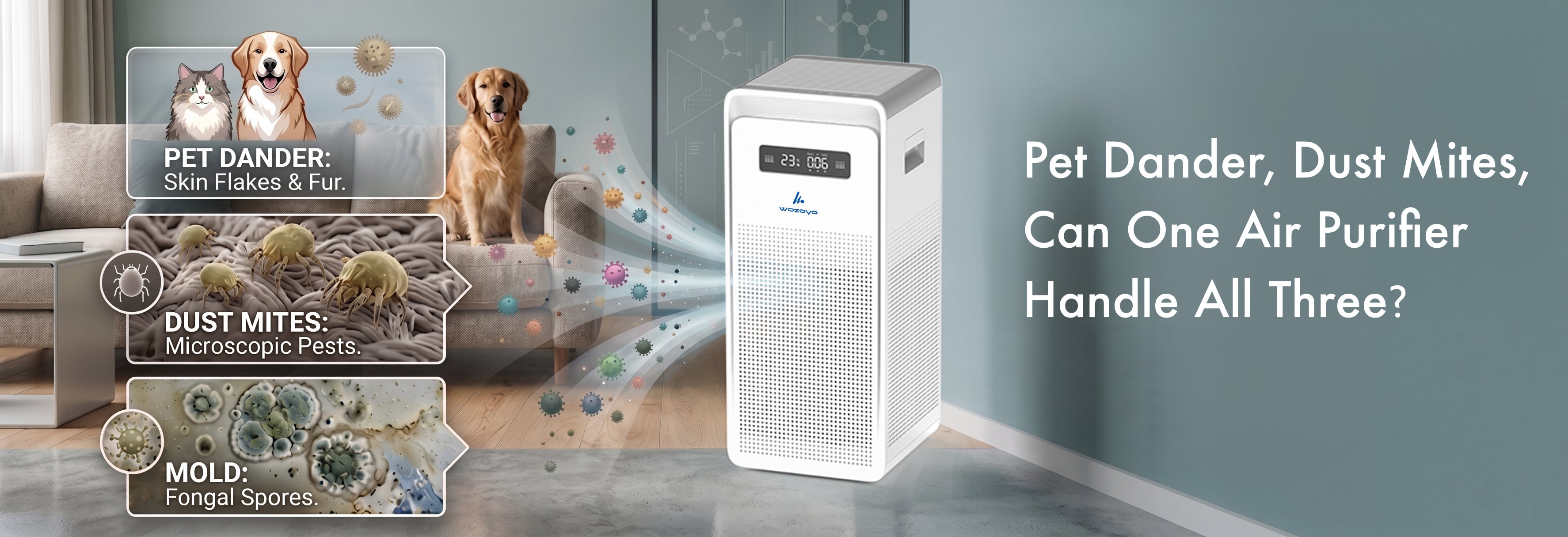
Pet Dander, Dust Mites & Mold: Can One Air Purifier Handle All Three
Individuals with chronic indoor asthma or allergies may encounter distinct challenges when residing in their homes. The three most aggressive and pervasive environmental triggers are pet dander, dust mites, and mold. Different airborne irritants originate from various biological sources, characterized by uniquely sized particulates and distinct behaviors within a living space. Such a variation tends to make homeowners think whether they need a special system to mitigate those threats or a one-time investment in high-quality air purifiers can clean all three environmental triggers from the air. You need an advanced system but with proper caveats.
A single and well-engineered air purifier can combat mold spores, dust mites, and pet dander. However, its success varies depending on the filtration technology, physical positioning, and air delivery metrics. You should assess the specific aspects of every pollutant and the required mechanisms to neutralize them.
Airborne Enemy Profiles
You should check what air purifiers catch to understand if they can deal with many threats. Microscopic elements are determined in microns, and all three culprits feature these profiles below:
-
Pet Dander (0.5 to 100 microns): Pet dander isn't animal hair since it contains dead skin’s microscopic flecks shed by rodents, birds, dogs, and cats mostly carrying proteins from urine and saliva. As such particles are jagged and lightweight, they stay suspended in the air for hours at the end for hours and quickly attach themselves to furniture, bedding, and walls.
-
Dust Mite Debris (0.5 to 50 microns): Dust mites are microscopic elements that feed on dead human skin cells and warm environments. The true allergen isn't a living mite. It is their disintegrated fecal pellets and body parts. Such particles weigh more than pet dander and usually settle quickly on the surfaces. They primarily become airborne when affected by walking, vacuuming, or bed making.
-
Mold Spores (2 to 100 microns): Mold, a kind of fungi, reproduces by releasing microscopic spores in the atmosphere. Even though dead spores are hazardous when inhaled, live spores can settle on damp exteriors and create new colonies, which build a compounding biological concern in areas with high humidity.
True HEPA Filter: The Key Solution to Microscopic Threats
High Efficiency Particulate Air (HEPA) is the core solution to all three microscope threats (dust, mites & mold). The air purifiers you choose should feature an authorised True HEPA filter to simultaneously capture mold spores, dust mite debris, and pet dander. According to global standards, a True HEPA filter is mechanically authorized to attract almost all airborne particles as small as 0.3 micrometers. As most dander, mold spores, and dust mite fragments settle smoothly above the 0.3 micron benchmark, a True HEPA filter works like a physical barrier to them. When air gets trapped via the dense woven web of fiberglass, such particles get trapped through diffusion, impaction, and interception.
The Multi-Stage Filtration Formula
Even though a genuine HEPA filter is a heavy lifter, a single unit can't effectively handle allergens with no support. The perfect modern air purifier uses a multiple-staged filtration system to fully process air without prematurely burning its components.
1. The Pre-Filter (The First Line of Defense)
Before air passes the gentle HEPA element, it passes via a porous pre-filter, usually made of activated/mesh carbon foam. This phase captures big contaminants, such as big mold fibers, heavy dust, and pet hair. The pre-filter prevents the clogging of the True HEPA filter, maintains high airflow, and extends the lifespan of the main filter from months to years by quickly capturing the heavy items.
2. Activated Carbon (The Odor and VOC Neutralizer)
Pet dander/mold doesn't exist in a vacuum and they pass smells. Pets introduce unique biological aroma and mold forms damp and musty odors. HEPA attracts solid particles and can't stop gaseous aroma molecules. An activated carbon stage attracts such VOCs and household aromas, which ensures a room looks clean and smells fresh.
3. UV-C Tech or Antimicrobial Coatings
As you catch the live mold spores, they settle on the filter surface. When the purifier is switched off in an extremely humid room, such spores may survive/multiply in the unit. The high-quality air purifiers can directly implement antimicrobial treatments in the filter fibers or use integrated UV-C light chambers to disrupt the microorganisms’ DNA, which ensures that the captured mold is destroyed.
The Air Exchange and CADR Rating
An air purifier can handle pet dander, dust mites, and mold if it moves sufficient air to keep up with the pace at which the allergens gather. Clean Air Delivery Rate (CADR) measures the capacity that shows the volume of filtered air a unit passes in a minute, mainly distinguished by pollen, dust, and smoke.
An air purifier should maintain a high air exchange rate to capture such particles when they are still floating as pet dander and dust mite debris settle quickly on surfaces. A machine should offer 4 to 5 Air Changes per Hour(ACH) for allergy sufferers. It means the full air volume in a specific room is pulled via the multi-stage filter after every 12 to 15 minutes, which denies particulates the chance to deeply sit in rugs and mattresses.
What Air Purifiers Can't Do
Homeowners should understand that air purifiers are designed to remove airborne particles to maintain long-term health and prevent unrealistic goals. An air purifier can't pull all the particles out from the fibers, as dust mites have colonized the mattress or a pet's dander has woven it into the fabric of the living room drapes. An air purifier will attract the floating spores but won't stop the mold colony’s expansion if the active plumbing leakage fuels mold growth behind the drywall. Air purification should always be treated as a pillar of an overall home hygiene routine.
In a Nutshell
You don't need to buy three machines to handle pet dander, dust mites, and mold. A single air purifier can handle all three threats, combining a certified True HEPA filter, physical pre-filter, and activated carbon layer in a chassis built for a room’s square footage. To make the most of a singular system, keep it in a room when you stay most of the time, keep it running consistently on an automatic/low setting rather than switching it on intermittently, and promptly replace the filters. You can intentionally clean the indoor environment and breathe across all seasons by combining a multi-stage air purifier with humidity control and routine vacuuming.